The Republic the Founders Built
The constitutional order the modern Left rejects — its premises about human nature, power, and the limits of civil government.
—
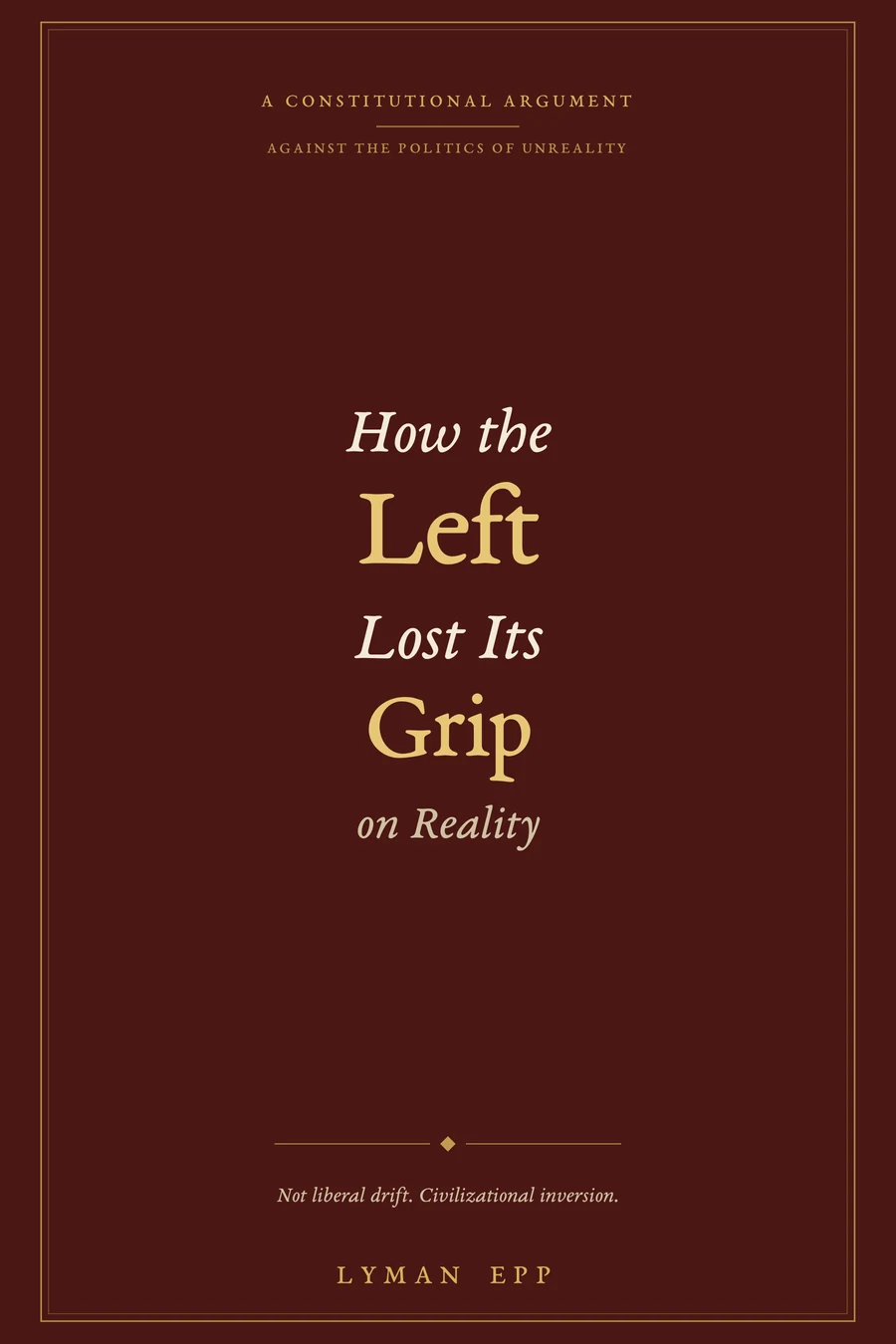
A Constitutional Argument Against the Politics of Unreality
Not liberal drift. Civilizational inversion. The American Left adopted a rival view of reality — and built institutions to enforce it.
You're on the list. You'll hear from Lyman directly the moment this book is live.
Where this book belongs
This book is written from the author’s convictions, but it is not a Bible-study volume and should not be treated as church instruction. Its subject is political and cultural: constitutional government, institutional capture, public unreality, and what political sanity requires now.
The thesis
The American Left did not simply become more liberal. Parties shift. Coalitions change. Something deeper happened. The modern Left embraced a rival view of reality.
What this book is
The first sign of cultural collapse is not that people believe lies. People have always believed lies. The first sign is that everyone knows the lie is a lie, but ordinary people are still required to repeat it.
That is where America now stands. We are told that men can become women, that males should compete in women’s sports, that children belong more to ideological institutions than to their parents, that abortion is health care, that racial discrimination is equity, that censorship is safety, that open borders are compassion, that criminal leniency is justice, that debt is generosity, that government dependency is love — and that the people who refuse to say these things are dangerous.
This book is the case that what we are watching is not random excess, but a coherent revolt against an order governed by reality. It traces how that revolt happened, what it replaced, and what recovery requires.
The modern Left’s deepest enemy is not the Republican Party. It is reality.
The argument
Civil government has real duties. It must punish evil, protect the innocent, defend the nation, administer justice, preserve public order, and stay within its lawful boundaries. When it abandons those duties for therapeutic management, it becomes softer toward disorder and harder toward dissent; softer toward criminals and harder toward the law-abiding; softer toward dependency and harder toward independence; softer toward lies and harder toward truth.
The state begins by promising care and ends by demanding custody. It offers to feed, educate, medicate, affirm, insure, protect, and rescue. Then it claims authority to define health, safety, identity, justice, family, speech, and morality. The citizen becomes a child. The bureaucrat becomes guardian. The expert becomes priest. The dissenter becomes a threat.
That is the replacement at the center of this book: constitutional government becomes therapeutic power.
What’s inside
From the progressive birth of expert rule and the maternalization of politics, through Marxism, the Frankfurt School, the New Left, the captured churches, media and Big Tech, judicial activism, the sexual revolution, abortion, the bureaucratic class, education as ideological custody, identity politics, socialism wearing the language of compassion, crime without punishment, open borders, climate emergency politics, the COVID dress rehearsal, the unfalsifiable impunity of the regime, and the failure of Republican opposition — to recovery.
Selected chapters
The constitutional order the modern Left rejects — its premises about human nature, power, and the limits of civil government.
What happens when the state pretends to be a mother: not tenderness, but possession.
Why Marxism functions like a religion — with its own doctrine of sin, guilt, salvation, priesthood, sacraments, heresy, and eschatology.
On the war against created limits, and why the body is the modern Left’s deepest enemy.
How an emergency placed the entire therapeutic, bureaucratic, ideological regime on full display — and what it revealed.
Why the Left rarely corrects: a worldview in which failure proves the need for more power.
The opposition that managed surrender instead of reversing it.
Before policy can be repaired, speech must be repaired. Before institutions can be rebuilt, truth must be honored.
Families. Churches. Schools. Institutions. Politics in its place. Recovery is not a slogan — it is a discipline.
From the closing chapter
Truth must be named. Then it must be obeyed. That is where recovery becomes difficult. Many people are willing to complain about the madness of the age. Fewer are willing to reorder their households, churches, schools, budgets, habits, loyalties, and institutions around the truth they claim to believe. Sanity is not recovered by commentary. It is recovered by honest reckoning, courage, discipline, and construction.
A diagnosis without obedience becomes another form of entertainment.
Who this book is for
This book is for the citizen who can see that something has gone wrong on a scale larger than any single election can repair — and who wants a serious account of how it happened and what to do. It does not assume the reader is a Christian, though it does not pretend to be written from nowhere. It is written from the conviction that there is such a thing as reality, that government has limits, that human nature is fixed, and that recovery begins where it always begins: with truthful naming.
—
A Constitutional Argument Against the Politics of Unreality
Not liberal drift. Civilizational inversion. The American Left adopted a rival view of reality — and built institutions to enforce it.
You're on the list. You'll hear from Lyman directly the moment this book is live.
Continue
Return to the political and cultural category for this book.